Sunday, January 24, 2016

Neolithic Agriculture and the Modern Gamer

Let's talk about monoculture. For everyone not up on their Mesopotamian agriculture practices, monoculture is a method of farming in which the same crops are planted on the same plots of land, year after year after year. It's simple, tidy, and utterly unsustainable. 

As it turns out, different plants require different nutrients. Each will take certain nutrients out of the ground and put others back in. This isn't a problem for the first year, or the first five years, or mayber even the first twenty. But after too many years of sustaining one kind of plant, the plot of land no longer has the stuff that plant needs to sustain itself. The crop has literally exhausted its own ability to exist.

But there's a solution. Farmers living in 6000 BCE might not have been educated in the modern sense, but they knew their work. And without knowing why, they understood that by changing the crops grown in a given field from year to year, they would ensure it remained productive for years to come. 

The concept of monoculture has an important lesson to teach in practically every field. In economics, we understand that all enterprise requires demand to sustain it, and in media, novelty and interest function similarly. The common element here is a single idea: any practice any field, from farming to banking to film production, has an expiration date. Stagnation might seem easy easy or tidy or traditional, but it's a surefire way to run yourself out of a job in the long run. The only cure is change.

Now imagine a world in which not committing murder is a radical choice. Where by the simple act of not killing any old person on the street out of convenience, or random malice, or sheer impulse, you have managed to distinguish yourself as a model citizen.

That's the current status of video games, on a whole. In the current culture of game design, offering a narrative where the player does not commit murder is a radical choice.

I don't want to retread the tired and false argument that video games are murder simulators that warp our youth into deranged lunatics. But when I can look out on a field of triple-A titles and count the number of games that don't require killing on one hand, count the number of games which aren't power fantasies on one hand - there's something wrong. Monoculture in media is just as unsustainable as in agriculture.

Say you're a moviegoer. Movies are important to you, because you grew up with them, and they're not just the medium with which you're most familiar, they're also a cultural signpost. You identify with characters from movies, you go to movie conventions, and you met most of your friends through movies.

Now imagine that 95% of movies coming out were horror films.

And to be fair - you like horror films. Some of you favorite movies are horror films. But when horror films are that inescapably abundant, you might start to long for a nice comedy. Maybe even a drama or a biopic. And even though you've asked for it, even though every non-horror movie to hit the silver screen makes millions because there's just no competition, practically every studio out there just keeps cranking out horror films.

And after years and years of this, you start to wonder: are movies even worth it anymore?

That's what it's like being a modern gaming fan.

(Well, plus some seriously toxic communities that I'm not even going to poke a stick at here.)

While there's nothing inherently wrong with violent video games - indeed, many of them are quite good - when there's nothing but violent video games to be seen, that's a problem. That much uniformity and saturation is just bad for the medium. It hurts fans, who lose access to a vast breath of potential innovation that just isn't being produced. It hurts game studios, who lose profit due frustration on the part of fans and talent alike. And artistically, it stifles new and unique narratives, choking the potential of one of the most versatile forms of media ever created and making serious discussion of video games as an art form all but impossible.

To be fair, indie gaming community has been making strides in this direction. A resurgence of narrative-driven games, of Tetris-like games too abstract for violence to enter the picture, and of thoughtful explorations or critiques of the medium has loosened the stranglehold of monoculture on modern gaming. 

Still - I'm sad to admit it, but this never such a glaring problem to me until I played a game which both critiques the omnipresence of violence in games without requiring the same violence from the player. (That game is Toby Fox's phenomenal RPG Undertale, which systematically questions aspects of videogames as a medium I've never before seen attacked.)

The most dangerous thing about monoculture is how easy it is. Some of it might stem from laziness, some from tradition, but I'd estimate the bulk of it is a simple matter of failing to challenge assumptions so deeply-ingrained we don't even think about them. Beating monoculture is not a matter of asking unasked questions, of opening doors that were closed. It's a matter of asking questions that haven't even been considered - of building doors where once we saw only walls.

And then, once our new doors are in place, finding new walls to knock down. 


Friday, October 2, 2015

Mishnah and Miranda: Commentary, Growth, and an American Myth

A decent part of my internal life over the last year has been pondering and exploring Judaism. I more or less lacked access to it as a kid, so I've been playing a lot of catch-up. It's good work. As I've learned and am still learning, there's an immense wealth of cultural, philosophical, and religious depth to it. 

(You could call me a bit of a dunce for not immediately realizing there might be something to those 3000-plus years of living tradition. But that would be rude!)

One thing I've found particularly wonderful about it is its emphasis on questioning - on examining our literature and traditions with a critical eye, on commenting and arguing and interpreting and reinterpreting. It's chaotic and combative and I LOVE IT.

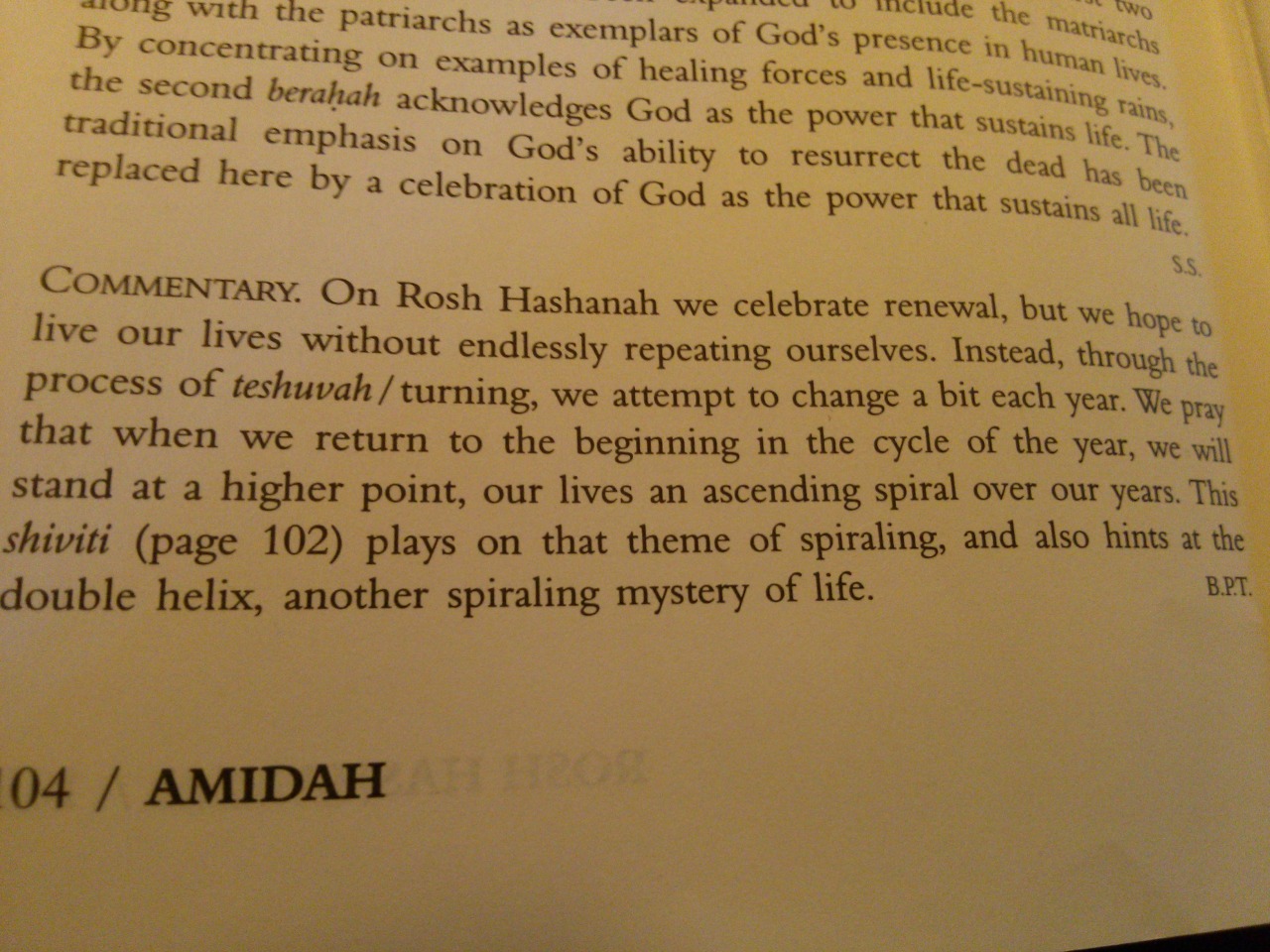
In that spirit, the prayer book at the synagogue I visited for Rosh Hashanah and Yom Kippur was absolutely filled with margin notes - some educational, some interpretive, some argumentative. I shamelessly took photos of some of my favorites, including this gem by Betsy Platkin Teusch:


I love this SO MUCH.

I love that the two most important holidays of our year are entirely devoted to self-examination, reflection, and improvement: finding what we could have done better in the last year, fixing any wrongs we've done, and finding ways to be a better person in the year to come. There's a huge emphasis on thought and awareness and sincerity and choice - and particularly on personal action.

We don't pray for God or whatever the heck is out there to save us; we pray for the power to save ourselves. Except "save" isn't even the right word - it implies a disturbing permanence to failure. What we pray for is clarity and humility and impetus: for the clarity to keep asking questions, for the humility to recognize our flaws, and for the impetus to correct them. We hope to keep moving and growing, and that by doing so we'll help the world grow with us.

Life is motion. If you put a rock on the floor, it will stay there until something moves it; if you put a cat on the floor, it'll be gone the moment you look away. (Or it might fall asleep. But its heart is still beating; it's still breathing; the potential for motion still lies within it.)

Our task in life, then, is nothing less than to move, and to help those around us to do the same. That's no small task. How many bildungsromans and Great American Novels have been written about some middle-aged guy who can't seem to work any change in his life? Self-improvement is hard. It takes constant, constant, grinding effort and a whole lot of humility. There's a reason hubris is such a classic theme - humans are always prey to the idea that we're already perfect, that what we are right now is the best we can be, that we have no flaws to improve on.

I've always been fairly agnostic. "Agnostic" isn't quite the right word for it - sure, I didn't know if any sort of higher being existed, but the question always struck me as kind of irrelevant in any practical sense. And even after examining my Judaism more fully, it still does. Jewish conceptions of God, to the best of my understanding, are abstract at best. That's by design.

God isn't a being, it's an abstraction. It's a unifying word we use to describe the qualities of the world that make it worth living in, and the qualities in ourselves that enable us to grow and make the world better. It's also a reminder that there are things beyond us, that there will always and should always be things in life we can't control. Without anything greater than ourselves we have nothing to remind us that we are flawed - that there are elements of ourselves we ought to improve on.

The presence or absence of a divine being in that equation are immaterial - the world has wonders enough.

NOTE: After this point, there will be spoilers for the musical Hamilton. If you don't want to see them, TURN BACK NOW.


Coincidentally, I was introduced to the music of Lin Manuel Miranda's new Broadway show Hamilton (now available on NPR!) just days after Yom Kippur. Hamilton is...a lot. In the same way as the portrait of Adele Bloch-Bauer (which I talked about a few weeks ago), it's just too much to take in - and I've only listened to it!

Hamilton is a musical marvel with an awe-inspiring webwork of self reference that it weaves into a language of its own. It's a modern story of rebellion, triumph, and liberation. It's a classical story of hubris, an all-American Greek tragedy with modern rap's blistering cascade of rhyme in place of the thrum of iambic trimeter. And it's a commentary; a commentary within a commentary.

Yes, it's a Greek tragedy - but the specific manner in which Hamilton examines its eponymous founder comes across to me as much in the spirit of Yom Kippur. Hamilton's boundless energy, breakneck pace, and flair for commentary and argumentation carry him like a meteor through the first act. The narrative's extolling of those traits invites the audience to get excited, to question and argue and hunger for learning. The show itself is also a commentary - a reinterpretation of an American myth in the language of today's oppressed that tells us we can make this country better than it was. It reminds us that our task as citizens is to help it move, to help it grow.

If that isn't Jewish, I don't know what is.

The same traits lead Hamilton to ruin in the second act - primarily because he fails to examine himself and realize that the pattern of choices which had worked so well before would need adaptation if he were to thrive after the war. Though Hamilton is a brilliant scholar and commentator, compulsive and relentless, it's ultimately his failure to examine himself - to weigh his choices, to make amends for damage done, and to set himself on a different course - that lead to his fall and death.

Hamilton is by no means a Jewish story - to say otherwise would be to discredit the brilliant black and Latino artists behind it - but its resonance with Jewish ideals and values is undeniable.

GO SEE IT. (Or if you're like me and can't afford to...listen to it!)

Monday, September 7, 2015

A Portrait Bigger Than Its Frame

Today has been a lazy weekend for me. And frankly, I think I've earned it. For the past three months I've been working six days a week, and even though the past two weeks have been vastly less stressful, I still hadn't really had a chance to actually relax and give my body a chance to recuperate. Y'know kick back, watch something relaxing...something like Daredevil...

(WHAT? You say Daredevil isn't a relaxing thing to watch? You're...probably right. But for me, the very concept of sitting down and not doing running around and doing things is strange and vaguely alien, so...yes. It was relaxing.)

After my two days of chilling out, I felt like for Labor Day I should at least do something. So I poked around online and found that a certain painting was on display at the Neue Galerie. That painting was Gustav Klimt's Portrait of Adele Bloch-Bauer - also known as Woman in Gold because Nazis didn't want to admit that such a beautiful picture could have been of a Jew.

A few months back, I watched a film of the same name, chronicling the portrait's history. I found it spectacular and moving, a brilliantly unsubtle treatment of how catastrophic damage the Holocaust inflicted on Jewish culture has rippled forward through generations, how our rage at that injustice is completely justified, and why the apathy of those whose grandparents had helped kill ours is so infuriating. And when I found that certain prominent film critics had misread its central message and in some cases conveniently forgotten it was about Jews, I wrote a rather irate counter-review. With that in mind, I practically couldn't not go.

Portrait of Adele Bloch-Bauer

Portrait of Adele Bloch-Bauer is housed in with some other contemporary Austrian works, but it dominates the room in every way. Even before you see the painting itself, the attention of everyone else in the room fixes on it, making it hard to seriously examine anything else.

And when you turn to it - it's too much to take in. The sheer visual spectacle of it, the details winding in on details, the weight of history, of memory that radiates from it ... I couldn't look at something like that all at once, just stand and absorb it, and I got a nasty headache trying. Instead I forced myself to examine just one thing at a time.

Physical details: the shape of Adele's dress against the flowing corona of her background, the infinity of eyes making up her body, the texture of the rich gold paints literally rising from the canvas, the wash of shapes and colors sweeping upward to her face, her face, framed in a kaleidoscopic halo. But the painting's patterns - her patterns - seem to hold secrets, to draw you in and whisper them to you, telling you secrets and stories you can barely remember. Stories that speak to me as a Jew on a level I don't comprehend, and I'm not sure I'm ever will.

Portait of Adele Bloch-Bauer is ... vast. I can't think of another word for this little 4'x5' painting. It seems to exist more thoroughly than the world around it - bearing the weight of history, of memory, all else seems like memory and shadow. It's harrowing and it's exhausting, and I can't see how anyone could ever stand to put it up on their wall, to deal with something that much every day. Even hours later, writing this, I still have a headache from looking at it.

And I'm glad - so glad - that I did.

Tuesday, August 18, 2015

Exhaustion: A User's Guide

I have been busy lately. Extraordinarily, exhaustingly busy. I work at a magazine two days a week and in retail four days. Retail, as anyone who's worked there or had the slightest bit of empathy for somebody else working there, is exhausting - physically and emotionally demanding, with shifts ranging from 9 to 11 hours at a stretch and unpredictable schedules that make it impossible to form any sort of sleep pattern. On top of working an average of 57 hours a week, I have a brick-wall networking calendar that has me all around New York at all hours, and I recently started taking dance classes.

And I'm going to be honest - I love it. I love being busy, seeing people all the time, having things to do and keeping myself moving.

I love it right up to the exact point when my body sits down and goes "nope, sorry, you're not doing anything else today". At which point I ignore it and keep doing things anyway.

Which...may not be the best plan.

So INSTEAD of slowing down, I've decided to expend more of my dwindling energy to build...let's call it a user's guide. A user's guide to exhaustion.


Here goes.


You may find your thoughts trend inward. You may have find it hard to focus on others. You may think yourself selfish. This is normal.

You may find your mind wandering, only to discover it was thinking of nothing at all. This is also normal.

At the same time, you may want to spend more time with others, but forget to contact them. This is also normal.


You may make mistakes.

You will make mistakes.


You may forget things.

You may forget appointments.

You may forget to go to bed.

You may forget that others care.

You may forget to trust.

You may forget to care.


This is all normal.


Your legs may give out. Maybe at the top of the stairs. Or on the train. This is normal.

Your stomach may ache. Your head may ache. This is normal too.


You will push yourself.

You may wonder if you can get up tomorrow.

You may wonder if you can keep doing this.

You can.

You may wonder how.

Monday, June 22, 2015

Dark Chronicle: Fixing the World


                Games do setting better than any other medium. While novels or films might pay some attention to their setting, a game is its setting, just as a novel is its text. Games communicate everything through their settings, so the setting has to be strong and memorable. Luckily, they’re well up to the task. To take advantage of the medium’s natural strength, many games focus on exploration, which is why Minecraft works. But exploration isn’t the whole story. Most exploration-heavy games like Mass Effect or Legend of Zelda still have a clear goal that gives them a sense of impetus and progression, and marks the boundary between a sandbox and an adventure.

                Adventures are about how the heroes become the people they need to be, and about the consequences should they fail. Not all involve travel, but many do, because travel links the heroes’ development to its impact on the world around them. Travel both causes and represents change: the process through which the heroes become the people they need to be. Video games do this fantastically well, because when players interact with a setting, they empathize with it. When Minas Tirith falls in Return of the King, we mourn the heroes’ loss of their home. When the Citadel falls in Mass Effect 3, it’s the place itself we mourn. We’ve connected with and protected it for three games, and when we can’t save it, we feel responsible. We feel like we’ve failed, and we want to take it back. We want to rebuild it.

                We can talk about how saving the world is important, necessary, but no medium can get us as personally and emotionally involved in saving the world as games. Books and movies make us want to save the people in the world, but only games make us want to save the world itself. They make their world our home, and we don’t want to let it break.

                But what if it’s already broken?

                In Dark Chronicle (also titled Dark Cloud 2), a 2001 action-RPG for PS2, you play as a young man named Max, who builds and fixes machines and carries a mysterious red stone around his neck. Max lives in Palm Brinks, a cozy industrial-age walled town closed off from the outside world. Though its railroad once brought in a booming age of exploration and growth, it’s since been shut down, the town gates sealed. The community is tight-knit and warm, but static: few residents know or care much about the world outside. Assassins soon try to take your stone, and you flee the town through the underground aqueducts.

                You step outside to find a world stripped of civilization. Using the railroad your mentor helped reestablish, you travel farther and soon meet Monica, a girl who carries a blue stone to match your red one. Monica is from the future, and grew up on the losing side of a great war against a figure known as Griffon, who has been wiping out humanity across time. Only Palm Brinks remains in the present. The stones have the power of time travel: Monica’s blue stone allows her to jump a hundred years back in time, while Max’s red one allows him to travel a hundred years forward. By using both in tandem, you can plant the seeds of civilization in your time: small settlements that will come into bloom in hers.

                Just because you’ve left Palm Brinks doesn’t mean you’re gone for good. The city is home. It’s a foundation to build on and a cushion to fall on. It supports you when you need to rise, and it’s there to catch you when you collapse. Palm Brinks is that world’s heart, and the love that went into building it oozes from every cobblestone and storefront. No area exemplifies that like the once-bustling train station. With the railroad line shut down, no trains go in and out, no passengers line up, and no clerks sell tickets. Still, the city maintains it like the day it was built. It’s gorgeous and baroque and empty: a place of motion, held in place, filled with potential that could break free with the spark of an engine. Like the world, it’s dormant, not dead. That the developers put so much effort into one area makes Palm Brinks a place that we, the players, care about. It’s not just somewhere we have to go back to; it’s a place we want to go back to, a place we want to protect. It’s not just Max’s home. It’s ours.

                Having a home means you’re not afraid to fall, because there are people who will catch you. The people there give you a place to come back to, and in return, you give them a place to go. Your task is to rebuild civilization, and you can’t have civilization without people – but the only people left are in Palm Brinks! They’re kind people, good people, but they’re complacent, and before they’ll venture out with you, you need to understand them and help them with their problems. You show each of them you care, and they learn to care as well, not just about the people around them, but the world as a whole. You’re the one that builds the settlements, but they live in them and bring them to life. Your adventure becomes everyone’s adventure, and once you’ve helped them become the people they need to be – helped them care, fixed them – they fix the world themselves.

                The people in your settlements aren’t the only ones making things better. There’s a beautifully cyclical nature to the way you rebuild the world. Once you’ve built your friends new homes, you travel to the future to find that over a hundred years, what you’ve built has blossomed under their care. Their descendants in turn give you tools and knowledge that you can carry back to the present and use to help the settlers. Ancestors nourish descendants and descendants nourish ancestors, building between them a world far better than the one that was lost.

You don’t just rebuild the world; you don’t just rebuild the world. You unite two groups of people, creating each other across a hundred years of history, to bring the world through its darkest hours shining brighter than it ever had before. To fix the world, you fix the people in it. You teach them to care, but before that, the game makes you care in a way no other medium could. It shows you a broken place, a beautiful place, a place full of loss but brimming with potential, a place you fall in love with, a place you can make better. And like the train, all it needs from you is a spark to come alive. All it needs for you to do is interact.


And you do. The rest follows.

Thursday, June 11, 2015

Fine

This is a little mini-story - well, a scene really - that I wrote during a 30 minute sit-down event with some other writers. Here's the prompt:

1)      Set it in summertime.
2)      Start with a lie.
3)      Include the phrase “Everything’s been different since…”
4)      End with a truth.


            “I’m fine.”

            Anna doesn’t respond. The broken air conditioner buzzes in the background. It’s even louder than the cicadas outside, and just as good at keeping the room cool.

            Jen wipes the sweat from her forehead. “I’m fine.”

           “You’re sitting in the worst café in Dallas, drinking at noon-“

            Jen’s eyes flick to her wineglass – almost empty – then to the waiter – busy.

            “-you just lost your job-“

            “Hey,” Jen interrupts, “that’s not-”

            “-and you’re with me.” Her words hang in the air like a car falling off a cliff. Outside, a particularly daring cicada raises its voice over the drone of the AC unit.

            Jen licks her lips, pondering. “Okay yeah, it seems bad, but when you think about it-”

            “You’re still with me.”

            Anna’s seen corpses give stares less dead than Jen’s.

            “And…” Anna speaks slowly, gauging Jen’s reaction. “I seem to remember you had some. Uh…words. About what you’d do, if you ever saw me again.”

            Jen grips her wineglass, and tiny ripples dance across the surface of the cheap white inside. “Anna…” The word sounds like broken glass between her teeth.

            Okay, yeah. Time to stop on that particular thread. No need to make her mad. Unlike the Jen of years before, the Jen of today probably wouldn’t do anything…but Anna saw no sense in chancing it. Perhaps a safer path was in order. “You wanna…talk about it?”

            “No.”

            “But you’re gonna.”


            “…I am, dammit. See, it’s shit like this that got you booted back in Houston.”

            Anna shrugs. “I wanted out. I got out.”

            The sound Jen makes sits about halfway between a sigh and a growl. “Yeah.” She tosses back the rest of her wine, raises the glass at the waiter. “Lucky fucker.”

            Anna flashes her a grin. “And now that we’re both out, we’ll ride across the desert like Bonnie and…uh…”

            “Louise?”

            Anna’s face hits her palm. “That…didn’t go where I wanted it to.”

            “Never does,” Jen says, but she’s smiling now. She lifts her wineglass. It’s still empty. She shakes her head. “It’s just, everything’s been different since Pedro left.”

            “Pedro left?”

            Jen nods.

            “So, Frankie…”

            “So,” Jen nods. “Frankie.”

            “Shit.”

            “Shit,” Jen agrees.

            The waiter ambles up, wordlessly fills Jen’s glass.

            “You’l be okay?” says Anna.

            Jen picks up her glass. She considers it, makes as if to toss it all back in a single gulp. Then she stops, sets it down. “I’m fine.”

Monday, April 27, 2015

Reviewing the Reviews: Woman in Gold

This weekend a friend and I went to see Woman in Gold. It was a rare pleasure. The story of Holocaust survivor Maria Altmann's struggle to reclaim a stolen portrait of her aunt from the Austrian government, it's tense and fiery, with a lot of heart and a genuine understanding of the family and cultural connections that were at stake during the Holocaust. Reviewers have dismissed it as melodramatic, hamfisted, lacking nuance, and so on. And they're right. It's not subtle! But much like Pacific Rim, the lack of subtlety isn't a bug, it's a feature. Woman in Gold is a tale about avenging a martyred culture, and that kernel of smoldering fury that lies at its heart has no room for subtlety. Woman in Gold is not melodramatic. It's concise.

Woman in Gold deals with cultural trauma with a level of empathy, insight, and clarity I've never seen before in a film. Though it's nominally about art restitution, the soul of it lies in its exploration of how something like the Holocaust, and the subsequent shattering of European Jewish cultural identity, can ripple forward in time and impact those born far later. I'm in particular a huge fan of the film's very conscious decision to evoke that trauma in form of the PURE ANCESTRAL WRATH which permeates every element of the film's construction, and makes the story a very personal one for every Jew who sees it.

It's also one of the rare movies about Jews that's actually about Jews. See, Jews are accustomed to seeing pretty much every movie that OUGHT to be about us - say, anything concerning the Holocaust - focusing instead on some Gentile standing tall with a shield and a cross. (I'm looking at you, Schindler's List.) The fact that a movie which is supposed to be about us for once actually is makes me really happy. (Though the decision to cast the stellar-but-still-very-Gentile Helen Mirren and Tatiana Maslany as very Jewish characters in a very Jewish film is...perplexing, and the decision to cast the mediocre-and-also-very-Gentile Ryan Reynolds is...dubious at best.)

I understand that giving the audience a Gentile they can identify with is an effort to broaden the appeal, but I'm unimpressed, to say the least. By viewing a Jewish story through a Christian lens, that kind of film loses out on any chance it had to inspire genuine understanding of and empathy for its Jews. Wisely, Woman in Gold chooses to focus on perspective and choices of actual Jews, forcing the audience into our shoes for a moment.

Of course, not a single review I read actually cared that Woman in Gold was about Jews. Most of them didn't even seem to notice.

Of the six or so reviews I read, EVERY SINGLE ONE very neatly sidesteps or sidelines the fact that this film is specifically about Jews and Jewish heritage. (The LA Times review doesn't even mention that Altmann is Jewish.)  Many bemoan the film's treatment of the obstructive Austrian government, much as reviewers bemoaned Selma's treatment of Lyndon Johnson. Their complaints, while arguably accurate from a historical standpoint, ignore the unique perspectives from which these films were written.

From the perspective of an oppressed minority, someone who understands your plight, who has the power to help you, but refuses to do so is a villain. Full stop. They may not be the worst you have to face, they may even be redeemable, but in the moment their utter apathy to your existence is horrific. As a uniquely black film, Selma therefore portrays Lyndon Johnson, who had the power to protect blacks with the stroke of a pen but chose to drag his heels, negatively. Woman in Gold portrays the Austrian government, which could have easily returned the plundered art pieces to their rightful owners but chose to hold on to them for its own benefit, in a similar light.

The worst reviews come from the most venerable publications. The New York Times, Telegraph, and Variety each pretend Woman in Gold is really about the concept of art ownership - the question of whether art can or should be a possession, the extent to which it should be democratized, and so on. It's an important topic, and would be a good critique to bring up if this were literally any other movie about art. In the case of Woman in Gold, however, shifting the discussion to the airy topic of art theory ignores the very pressing fact that A GENOCIDE HAPPENED, and the overriding demand for justice outweighs any theoretical, academic concerns about who owns art.

The damage of that singular attempt to plunder, enslave, and ultimately annihilate an entire people ripples forward through history in the form of a cultural scar that manifests as alienation, isolation, and a host of other insidious problems invisible to those who don't live with them. The enormity of the crime is such that it can NEVER be repaid. You can't give us back our grandparents and great-grandparents, our heritage, our homes, our ability to live our lives without the lurking suspicion that some day, for no particular reason, Gentiles might collectively decide it's a good time to murder us all.

You can never pay it back. But you can at LEAST admit what you did. You can at LEAST give us back the things you stole.

These critics' attempts to divert the discussion are painfully ironic, considering that Woman in Gold depicts the Austrian government of using the exact same tactics to ignore, belittle, and delay. Particularly striking was a moment early in the movie, when a minor Austrian functionary meets Maria to say - (pardon the paraphrasing, I'm working from memory) -  "Not everything is about the Holocaust. Why don't you people ever quit?"

But that's a code, and it's a simple one. It means, "Your existence is inconvenient to me. Can you please stop?"

And when a film critic tries to turn a conversation about the Holocaust into one about art theory, all I can hear is that. Just below the surface.


(By the way, I'm planning to start writing more reviews of reviews! If you liked this piece, and there's a review of a book/movie/show you want me to talk about...just comment right below!)

Wednesday, March 18, 2015

Jupiter Ascending gets smart about fairytales

You might have heard a lot of noise about this movie Jupiter Ascending. You might have heard it's awful, it's poorly written, it's very very pretty, it's awful (but in the fun way). There's a common strain here. Because this movie is openly glittery, absurd, fantastic, and ridiculous, because it embraces its tropes and archetypes so wholeheartedly, nobody seems to take it very seriously.

So let's try taking it seriously.

I mean what the heck, right?

A few critics have called Jupiter Ascending a fairytale, a Cinderella in space. They're half right - it's a fairytale, but it's not Cinderella. Well, not entirely. It's also Tam Lin.

For people who didn't grow up around a bunch of Celtic folklore nerds like I did, Tam Lin is the classic tale of a lord's daughter who wanders into the Forbidden Wood (because seriously has anyone ever done literally anything other than wander into that place?) There she meets hunky knight Tam Lin, sleeps with him, goes home, finds out she's pregnant, goes back, finds out he lives there because he was enthralled by fairies an unspecified number of years ago, and finds out ADDITIONALLY that the fairy queen plans to kill him in about a month. One month later she steps out to meet him and proceeds to save his life by yanking him off a horse and wrestling him to the ground as he transforms into all manner of wriggling wildlife. She then hauls off  takes home her young shirtless nubile prize noble knight and marries him. The end!

Make no mistake - Jupiter Ascending is a fairytale. Even though they're technically human the Abrasax are fairies, and even though he's a shirtless doggie on SPACE ROLLER SKATES Caine is Tam Lin. That's important, because in fairytales - the old fairytales - fairies are monsters in their just as vicious and vampires and werewolves. And the Wachowskis understand them better than almost any creator I've seen barring Terry Pratchett (may he rest in peace).

At the core, every monster we imagine up represents something dark in ourselves. Vampires represent repressed desire. Werewolves represent repressed fury. And fairies...fairies represent privilege.

As beings of privilege, fairies are Better Than You, and they'll do anything to convince you of that - trick and tempt you, bedazzle and beguile you - because if they can convince that your place is at their heel, they've won. You're theirs.

But here's the secret. Fairies can't create. They can't build, they can't craft, they can't cook or weave or write. All they can do is consume, so they build a world of glamour to convince others to feed their hunger. That glamour is a lie of course, but it's a lie strong enough to build empires on.

Privilege is the fairies' power, but it's also their weakness, because they're bound to follow its rules. They have to behave gracefully and glamorously, or they lose their grace and their glamour. And once you can see beyond all that glitz and glamour and power...they're really not that impressive. You don't have to serve them anymore.

You're free.

Let's take a look at that word. Glamour. It's no coincidence that we use it, a word once used for the magic of lies, to describe the rich and powerful in our own society. Much as the fairies shape beauty and lies, our elites use their power and their privilege to shape the definition of beauty to their own ends. We see them in magazines and advertisements in all their glory, and we want to be like that - and we can. For just a small monetary fee right now, and a larger fee over time in the form our diminishing self-worth.

It's a glamour more real than any fairy could cast.

But it's still just a lie.

Saturday, January 31, 2015

Mass Effect 3: How It Ended, and How I Wasn't Angry

So if you know me in anything more than passing, you're probably familiar with my astounding lack of knowledge of most things pop-culture related. See, I grew up in absence of TV, and almost all of my media exposure was in the form of books and video games. 
I AM getting better at it, though! This partly involves working at a media and culture magazine, and partly involves furiously catching up on Things I Need To See. Mostly shows. Occasionally movies. And on very, very rare occasions, games. 
Specifically, certain very high profile games which I somehow missed.
Anyway, last weekend I went up to Boston to visit some friends who happen to possess a certain game system I lack, with a certain game I've been dying to finish for a year and a half. And as luck would have it, a certain winter storm trapped me there with little to do but finish that game.
So I'm happy to announce that in my latest round of Catching Up On Media Several Years Too Late For Anyone To Care...I finally finished Mass Effect 3.
(I know I often discuss at length the Nature and Meaning of whatever bit of media I'm analyzing, but I'm going to assume you know how Mass Effect 3 ends. I knew how it ended before I even started the first game. If it's not a spoiler to mention that Snape kills Trinity with Rosebud, this isn't a spoiler either. My point is, if you somehow avoided the colossal storm of angry nerds yelling after the game's release, and you don't want spoilers, now is your last chance to stop reading.)
(Okay, I can see you didn't. Good!)
Even after dying six or seven times in the grueling penultimate battle - even after dying several more times against the final (very weak) enemy because I had played as a Vanguard and this fight me to actually aim at something - I finished Mass Effect 3.
It was a wonderful and immensely experience, and...
(I'm now stuffing my ears with wax in preparation for the inevitable tide of Nerd Rage.)
(Speaking of Nerd Rage, I'm going to be consistently referring to Shepard as female. If that bothers you, you should probably do some serious thinking about your personal opinions on women and why you hold them.)
...I'm not counting the ending out when I say I iked it.
I can understand the problems that a lot of people had with the ending. It was imperfect. But I don’t think its flaws were nearly as serious as the bulk of the audience seems to think. All in all I’m about…80% satisfied with it.
But because the bulk of the audience seems to have developed an cultish dedication to shitting on the ending, I feel like I have to answer that.
So. Let’s talk about the 20% I didn't like.
There were two major I could see with the ending. First was the change in tone between the intense, emotional, and philosophical clash between Shepard, Anderson, and the Illusive Man and the almost serene atmosphere of the scene following it. As I saw it, this reflected nothing so much as Shepard's utter exhaustion. She's not just tired, she's so tired she can't even feel it.
That  worked because the Crucible was always going to be a moment of transcendence, and to accept that sort of moment, to really understand it, we have to be at our lowest. To accept the miracle, we have to first accept that the situation is beyond our control. Mass Effect 3 is about bringing the entire galaxy to this point. That's what the Crucible is. It's a shot in the dark, a prayer, because nothing else will work - and at the end, Shepard accepts it. She can rest.
But it is a change in tone, and it's a sudden one. Jarring, even. And for some people, that can break immersion.
The other problem was that the writers didn't seem to put much thought put into what Synthesis would actually mean.
I don't have any problem with the fact that Synthesis existed. The Crucible was this Big Thing We Don’t Know What It Does, which would naturally to several options, any of which would be drastic, even transcendent moments that altered the very nature of this universe
Destroy was always going to be on the table, because that was Shepard's original goal. Control was going to be an option too, because that was the Illusive Man's goal. But both are awful! The writers did well to recognize that. Destroy doesn’t fix anything in the grand scheme - it takes care of the Reapers in the short term, but does nothing to stop them from coming back. It's not a step forward; it's a step back. A Shepard who chooses Destroy is the one who looks over the precipice, sees the new world that could be, and backs away. It's passive, and it's cowardly.
Control is worse because, to quote the main villain of Fullmetal Alchemist, the whole point of it is to CAST GOD DOWN FROM THE HEAVENS AND BECOME A PERFECT BEING. It's the height of arrogance. There is a reason Control is the Illusive Man's goal, and it's the same reason he's a villain. Sure, you can say it’s better because Shepard is better, but that’s EXACTLY THE SAME ARGUMENT THE ILLUSIVE MAN MAKES. That he deserves to rule the universe  because he's BETTER than other people. Which should be a pretty big damn hint that it's wrong.
(And the less we say about Refusal, the better.)
No, the correct answer always had to be something truly transcendent. An active choice, a choice to move the world forward, but without arrogance. Synthesis was clearly supposed to be that option. It needed to be there.
But…I don’t think the writers really fully thought through what it actually entailed? Or if they did, they didn’t work hard enough to make those thought processes clear to us - basically, they got lazy.
Yes, there needed to be a moment of transcendent, universal change. But why did that moment of transcendent change SPECIFICALLY have to be the union of synthetics and organics? I’m sure there are arguments, good ones - but I’d like to see them within the actual game. And I'd ideally like to see them made by someone who ISN’T A REAPER.
I's okay though. It's okay.
I’m like 80% satisfied.

Sunday, December 14, 2014

Writing is hard

God damn but it is hard.

The thing I've come to understand about my brain is that while it loves writing, it doesn't actually like it. At all. For me, writing is grinding, painful, hard, hard work, and my lazy brain will take literally any excuse to avoid doing it. 

A lot of those excuses are pretty good! I'm a busy person. I work 5-6 days a week at two jobs, have all sorts of chores to handle, as well as this burning and inconvenient need for a social life. There's a certain amount of give and take, but they're all important, and I can't just ignore them.

Sometimes, it's not quite like that. Sometimes, when I actual I sit down at a blank page, blink, shrug, and go "nah". Actually if my brain had its way that's how it would be all the time. In order to actually get to putting down words I more or less have to put my own brain in a headlock and wrestle it into a very talkative submission. Occasionally it drops into hyperfocus mode and I blaze through page after page, but more often it never stops being a struggle. It will take any opportunity to get distracted, think about something else, even just check out for awhile.

When I look at a blank page I see a trackless wasteland, obscured in fog. It's terrifying. I can look a certain distance ahead, but if I plan too much I end up being wrong and having to revise, and if I don't plan enough I look at that big white page and mumble "perhaps tomorrow".

But that's the thing about creation. It doesn't get done tomorrow; it gets done today. Tomorrow is this nebulous ideal time to write when the light is perfect and you're energetic and awake and the stars have all aligned in the house of Saturn or something. Tomorrow is a hypothetical. When the next day becomes today, you'll still be planning to write tomorrow, and then the day after that, and the day after that.

Don't do that.

Write today.

Wednesday, November 26, 2014

On Ferguson


How much more is there to say? And what can I, as a white Jew, add?
Very little. Very little.
I could mention that roughly 0.003% of grand juries fail to return an indictment...but that's been said.
I could decry Special Prosecutor McCulloch for scuttling a procedure slanted entirely in his favor due to personal interest in the case, for his tone-deaf, milquetoast statements blaming people who talk about things online. But that's also been said.
I could rail about the utter arrogance of white people in murdering blacks with impunity, then throwing them in jail for being angry about it. But that's been said too.
I just...I don't know. I don't.
Bottom line is, in a procedure so heavily slanted toward the prosecution, we cannot blame anyone but the prosecution for failing to charge Darren Wilson for his crimes.
But we can blame ourselves. Because we're all part of this fucked-up system. We're letting it happen. By sitting down, covering our ears, we're letting it happen.
A grand jury hearing is not a trial. A trial is meant  to find out whether or not the law was broken; a grand jury hearing is to see if we even want to find out. By failing to even charge Darren Wilson, we're shouting loud and clear that we don't want to know.
We're not saying that Darren Wilson didn't murder Mike Brown. We're saying we don't care if he did.
"I don't care" are the three most terrifying words I know.

Saturday, November 22, 2014

Mini book reviews, and exciting news!

You might realize I haven't been updating this blog with my usual languid-but-steady pace. There are a number of reasons behind that, but it really amounts to a combination of real-life hassles, other writing projects which for various reasons cannot appear on this blog, and one bit of extremely exciting news that's taken up a good bit of my time.

You'll have to wait until the end for that one. Sorry. (Not sorry.)

One thing I have had time for is lots of reading! Public transit is like that. So here are the books I've read recently, in brief.

Words of Radiance (Brandon Sanderson): The second book of Sanderson's epic fantasy saga The Stormlight Archive. Imagine Game of Trones set to the soundtrack of Pacific Rim. Epic in every sense (including its weight), this series is a joy to read and a genuinely optimistic take on a genre that tends toward the cynical, especially recently. It's also refreshingly diverse: almost nobody is white. (Too bad nobody told the cover artist.)

Code Name Verity (Elizabeth Wein): The story of two young British girls, a pilot and a spy, best friends separated in World War II. It's beautifully written and brilliantly constructed, and the relationship between these two young girls - whether you interpret it as romantic or not - might be the most positive, wonderful, and human dynamic I've seen between two characters, ever.

American Born Chinese (Gene Luen Yang): First in my binge on socially-conscious graphic novels, this is the story of a young Chinese immigrant growing up in California in the '80s. Its depiction of cultural isolation, erasure, and racism resonate powerfully with anyone not cut from the White Straight Christian mold, and in simple but effective terms it reminds us that being who we are is not a bad thing. It's actually pretty neat.

The Rithmatist (Brandon Sanderson): Sanderson's YA novel, read because I needed a break from the heavy emotions of Code Name Verity and American Born Chinese. A murder mystery, The Rithmatist suffers from excessive simplicity (even by YA standards) and its failure to find much for the young protagonists to do. Sanderson's clever magic systems, likable characters, and subtle social consciousness make it an worthwhile read, but they're like strong horses pulling a squeaky carriage. Decent, but far from Sanderson's best.

Persepolis (Marjane Satrapi): A graphic novel memoir of the Iranian Revolution from a woman who grew up during it. It's teaches a lot about Iranian history culture, but aside from the delightful Marjane herself, few of the characters receive attention besides a nameplate and an explanation, which makes it hard to connect with any of them. Persepolis is entertaining and a very good history lesson; I'm not sure it works as a story.

Maus (Art Spiegelman): Another graphic novel memoir, this one detailing the author's father's survival of World War II as a Polish Jew. Interspersed with his father's narrative on the Holocaust are scenes in the United States depicting Spiegelman's tense relationship with his father. Maus is...intense. It doesn't editorialize; it simply presents the events as they occurred, and gives us room to empathize with the people experiencing them. Read it. That's all I can say without a lot more space, and time to parse it.

And now, the news! I'm very excited to say I've landed an internship at CBS's Watch! Magazine! Two days in, it's already amazing, and I'm meeting great people and learning a lot.

Cheers,
Simon

Saturday, October 11, 2014

Swimming with the student loan sharks

Swimming with the student loan sharks

I'm from a very unhappy medium in the lower middle class. As an electrician my mom made just enough money to disqualify me for a Pell Grant, but nowhere near enough to fill the gap between scholarships and tuition at Brandeis University. The "solution" was $50,000 in loans.

The first monthly payment on my Perkins Loan hit just after I moved to New York, and was equal to roughly all my money. The kicker: I received the bill several days after it was due. I'd just moved, and their confusion as to my whereabouts was perfectly reasonable. It was still terrifying, but nothing seemed amiss. The obvious solution would be to get in touch with Campus Partners, the company in charge of the loan, to explain my situation and get everything squared away. That should be easy enough...if Campus Parners answered their phones.

Or, after taking half an hour to answer their phones, they didn't hang up.

Or if their phone operators weren't specifically instructed to obscure and omit relevant information, even when specifically and repeatedly asked.

Or if they made it possible to get in touch with someone with any authority.

Or if they had an email address, or any other way to get in touch with them online.

After several days of calling Campus Partners despite their determined resistance, I learned that I could submit a forbearance request. In paper. No electronic documents allowed, even though an electronic document would be far quicker and easier for everyone. Apparently Campus Partners was only willing to process urgent legal documents in the least efficient form possible, which seemed to match their “delay and ignore” M.O. just fine.

Putting together this forbearance application took time. It required documentation of income, which is hard to pull together when you've just moved twice in a single month and commute four hours a day day. It also required a printer, which I didn't have.

It took a few weeks to put this form together, but just as I was about to send it - while at the post office, just before I sealed the envelope - Brandeis financial services called me and told me I could submit it electronically, straight to them. When I mentioned Campus Partners' behavior to them, they were concerned, and said they'd look into it.

Brandeis also told me it might be a good idea to consolidate my loans, to which I replied, "Huh?" Campus Partners had left out the fact that I could mash my Perkins Loan together with my Stafford Loan (whose monthly payments were based on my income) so I wouldn't have to pay extra money each month. In short, I’d be home free, at least in the short term.

After sending out the forbearance application and the loan consolidation request, I felt a weight lift off my chest, followed immediately by suspicion. If Brandeis could accept the form electronically at a moment's notice, why did Campus Partners need a hardcopy and several weeks to process it?
                       
Ah well, it wasn’t my problem. My forms were in, and I was set, right? Right.

About three weeks later, I got another letter from Campus Partners. Looking at the envelope, I nodded. This would be the confirmation that they'd received and processed my documents. Still nodding, still smiling, I tore open the envelope to find a...
                                                 
final demand letter?

I blinked and read it again. No, it definitely said "FINAL DEMAND LETTER", and it was definitely threatening to send my loan to a collections agency if I didn't pay up now.

After freaking out for ten minutes, I contacted Campus Partners to check if they'd received the form I sent two weeks ago. They said they hadn't. I then called my mom, Brandeis's financial department, and my boss, looking for some sort of way out of this. I also contacted an old mentor of mine, who mentioned that student loan servicers have a shady reputation, and that this one seemed shadier than most.

That put me on edge. Since they'd started sending me letters in May, Campus Partners' correspondence had been continually late. Feeling a bit sick, I took a closer look at the letter, and more importantly, at its envelope.
 
Dated July 12th...

...and postmarked July 23rd.


As you can see, the letter is dated July 12th, but postmarked July 23rd. For some reason, Campus Partners delayed urgent correspondence by 11 days, and deliberately sending my loan into collections seems the only motive for doing so.

In the past three months, I've seen Campus Partners make themselves difficult to contact, obscure relevant information, deceive both me and Brandeis University, fail to acknowledge receipt of forms, and send forms late to prevent me from responding.

I was lucky. When I spoke to Brandeis again, I learned they'd already pushed through their forms, and I was in the clear. But what if I weren't? What if someone else, dealing with this company, hadn't kept hammering at their phones for weeks on end? What if their forms got stuck in the mail? What if Brandeis hadn't picked the exact right moment to call? I don’t want to think of that.

And frankly, I shouldn’t have to. If our education and our livelihoods depend on the good faith and credit of student loan servicers, it is Brandeis’s responsibility to ensure that we can rely on them. It is unconscionable that this university deals with a company that deceives and robs those students it should aid and protect. Brandeis needs to vet its student loan servicers carefully and actively monitor their behavior to prevent this sort of abuse.
         
Campus Partners is a loan shark in graduation robes. You shouldn't have to with them, and Brandeis University shouldn’t make you.

An abridged version of this story has been published on the Brandeis Hoot.


Saturday, October 4, 2014

On Yom Kippur

With the help of several wonderful friends, I think I've finally been able to understand and parse the meaning of Yom Kippur and Judaism this year. It’s been wonderful and painful and enlightening, and I feel I’ve become a better person, a better version of myself, for it.

Have I?

I've been striving to understand the holiday through action: reading through the prayers in full even if i don't understand or agree with them, finding small ways to do good, to do better. But I've failed. That doesn't mean it was pointless. But I have failed.

I have not apologized to those I've wronged. I've been callous to friends and family, taking their presence and their love for granted. I have not forced myself to confront my own behavior, to better it.
The last of those, the least, I can make right.

When I graduated college, I had to move back home. And I hated it. Despite my mom's efforts to compromise, to support me, to help me be comfortable, I felt stuck, imprisoned. Alone, uprooted from the community I built with my friends in college, lost.

I wasn't wrong for feeling that way. Isolation brought out the worst in me: my loneliness, my moodiness, my tendency to view others as resources. I could feel myself becoming a worse person, and my awareness just made me hate it that much more. If I wanted to be the person I wanted to be, I would have to get back to where I belonged.

With little else to do, I worked toward that obsessively. In the name of keeping myself moving forward, I blinded myself to everything but my goals. That I eventually succeeded does not justify my behavior at the time. I didn't think about my past, and I was careless for the consequences of my actions in the present.

I abandoned friendships and burnt bridges. I was callous and distant to those around me. I relied too much of the kindness and support of a few friends without a thought for their own needs. I may not have hurt them, but I did take advantage of their generosity.

When you start to see someone as a hero, it's easy to forget they're human. It's easy to forget they need care too.

I'm sorry.

I can't fix the way I acted last year, but this year, I will be better. Where I once ran from others, I will stand by them. Where I once burnt bridges, I will build them. Where I once took love, I will give it.

I will fail, of course. I understand this. But if I can read this post a year from now and say honestly that I am a better person than I was today...

...well, that's worth something.

Wednesday, October 1, 2014

Matt Stover's Test of Metal puts us at the labyrinth's heart

I've played Magic: the Gathering since I was pretty young, but I make a point of not reading the licensed tie-in novels. To put it bluntly, they're not very good; at best, a guilty pleasure. In fact, I probably wouldn't have opened Test of Metal at all if not for one small detail: Matt Stover's name on the cover. A long time ago in a town far, far away, I read his novelization of Star Wars Episode III, and found it far better than the actual movie. Okay, I thought. This could be worth my time.
And it was.
Under Matt Stover's hand, what could have easily been Another Stupid Contract Novel becomes a genuinely deep discussion of how power stifles understanding and how trial and insight can help us become the best versions of ourselves. It’s about changing and becoming the person you need to be, and then, when that person is no longer the right person, becoming again.
Particularly brilliant is its labyrinth motif. There's much discussion of their design and purpose, but the true stroke of genius is Stover's careful eye toward structure. Test of Metal isn't just about labyrinths; it is a labyrinth, circling around and around until we end at the middle: the center, the goal, the answer. And like our antihero Tezzeret, we you don’t learn the solution so much as we become the person at the center, the person who understands themselves and the nature of the puzzle.
In a labyrinth, power is weakness, because having power makes us impatient, simple, direct. Power entices us to cut straight to the goal…but a labyrinth has no goal. There is no prize, no treasure at the center; the treasure is who you become by following its path. The center isn't a destination, it's just a signpost marking the end of the journey. The journey is the trial, and the trial is its own reward.
Even if you don't play Magic, I'd pick up this book. Some unfortunate casual sexism aside, Stover has crafted in Test of Metal a work of keen insight into the nature of human growth and progression.
Read it once to reach the center, to understand the puzzle. Then read it again

Sunday, August 31, 2014

Speak again the ancient oaths: Trauma, recovery, and the Stormlight Archive

"It is the nature of the magic. A broken soul has cracks into which something else can be fit. Surgebindings, the powers of creation themselves; they can brace a broken soul, but they can also widen its fissures." - from the back cover of Words of Radiance, second book of Brandon Sanderson's Stormlight Archive

Brandon Sanderson is known widely for works of epic fantasy with well-explored, almost scientific systems of magic. His Stormlight Archive, doesn't break the formula, but it does bend it with Surgebinding, a highly personal and human system that grants characters powers based on their personalities and ideals.

Using magic to literalize a character's other traits as a form of power is a common trope in fantasy, and I'm a big fan of it. It allows the writer to present the supernatural in an insightful and deeply human way, turning what might otherwise be a flashy action sequence into commentary on its characters without being any less thrilling. It's a good technique, and I've seen it done well in a lot of works.

Even by those standards, the magic of the Stormlight Archive is something special. Only characters who've undergone exceptional trauma and started on the path to recovery can become Surgebinders, and the exact form that their recovery takes determines what powers they gain.

In other words, Surgebinding literalizes recovery from trauma. That's more than good technique on Sanderson's part. That's wisdom.

As Surgebinders recover and grow, their powers increase; if they slide backward, or stop growing, or grow into something harmful to those around them, their powers fade or even vanish. Recovery isn't an event, it's a process, and it never takes the same form for two different people. One may cope and advance by finding strength in oaths and loyalty, another in exploring the nature of truth and lies.

Nobody is ever the same person they were before trauma; to survive it we must to change and adapt, and continue changing and adapting. Trauma hunts us down out of the past, tries to pull us back, break us again, and to fight it we develop, discover, and grow into something new. That we've been hurt is no excuse to stop growing. People change, or they die.

Life before death.

Growth is risky. Change is risky. Even if this new form is what we need, it may be toxic, something stifling, or even dangerous to those around us. Recovery is power. That we've gone through hell to gain that power is no excuse for abusing it. It's our responsibility to ensure that we develop in a way that protects and nurtures those around us, that the power we gain from recovery lifts up those around us instead of strangling them. And that takes a kind of power of its own.

Strength before weakness.

Recovery isn't an event; it's a process, and a struggle, and though we might be past our darkest moments, that struggle is hard. And it doesn't end. We keep changing, we keep growing, we keep advancing, though there's no goal in sight, no end to that work. That we can't see the end of our path, that we will never truly grow past our trauma, is no excuse to stop growing. All we can do is be the best we can, and keep moving.

Journey before destination.

As humans have the drive, the imperative, the responsibility to grow, to recover from our trauma and to ensure that our growth shapes us into a form that helps those around us. Sanderson is wise to recognize that, and genius to present it like this.

Thursday, August 21, 2014

The price of standing up

Last Thursday, I attended my first protest.

You might have heard about it on the news, when several thousand people marched from Union Square to Times Square to protest the police brutality in Ferguson.

Organized by word of mouth and social media, the protest was described as a silent vigil in Union Square. At 7:00 it got of to a confused start: whatever it was, the event wasn't a silent vigil, and the moderately-sized crowd didn't quite seem to know what to do with itself. Most talked and milled around, some stood silently, and a few activists, mostly black, chanted: Hands up, don't shoot and No justice, no peace. I didn't join in; I'm white, and I wasn't sure it was my place. The feeling seemed pretty common among the white attendees; while we definitely wanted to support the activists, we weren't quite sure how to do it.

Then crowd shifted: someone had started moving, and the rest moved to follow. They spread out and sped up, and the activists led their chants like a conductor leads an orchestra, raising them, using their footsteps like a metronome.

For thirty blocks we marched like that, right through traffic down the middle of Broadway all the way to Times Square. We held our arms up until they were sore and shouted until our throats hurt. The white supporters gradually figured out what to do, and started to lead chants when the black activists grew tired.

And people joined.


A lot of people.

Just around dusk, right in the middle of Times Square, next to the bright blue NYPD station, the march ground to a halt.


Turns out the police had blocked us. After about ten few minutes they let us move again, funneling us up to the northern part of Times Square...


...where they blocked us again.

With the march stopped, the chants became quieter. The black activists tried to keep them alive; a few of the white supporters helped out. (I joined in as best I could, but my throat was raw.) But without the movement of marching, the energy wasn't there.


About twenty minutes later, the police let us go, under a few conditions. We had to walk in a narrow line on the sidewalk, head south out of Times Square, then go west. The activists warned that this was a tactic to split us apart; we had to stick together. And we followed them westward, toward Port Authority, the police at our side every step of the way. We walked right down the center of the street, hands up, screaming, then turned a corner...


...right into a wall of police vans.


Once we were bottled up against their blockade, they surrounded us...


...pushed us together, and backed us up against the sidewalk.

Ten minutes later, they hadn't made any indication they intended to let us move. In the crowd, people started passing out a phone number: the National Lawyers' Guild. "Write it on your arm," they said. "If the cops take us in, they'll take everything you have."


I felt exhilarated. I was doing something important! We were making noise, forcing people to pay attention to our outrage with the behavior of the our police. This meant something, and I was proud to be part of it.

Then I looked around.

The black men and women around me were definitely excited, but not exhilarated. They made jokes at the police, they chanted, but they were not exhilarated. You don't feel exhilarated with your life on the line. You feel terrified.

Unlike me, they had something to lose here.

That was the main difference between the white protesters (myself included) and the black ones. For the white protesters, tearing down this vicious and brutal system that supports these racist, overarmed, hyperaggressive police was an important cause, and we were proud to do our part. But what did we have to lose if things went bad? We were white. The police wouldn't really hurt us. We'd get a few bruises, a night in the precinct, a reprimand at most.

For the black protesters, this this was their lives. And to try and raise their head, to stand up and force America to acknowledge them as more than animals, they risked beatings, jail time, and death at the hands of the police. And they still stood up. And more than that, they led others to stand with them.

The police kept us penned in at the side of the street for about half an hour. Toward the end of it, they started making what seemed like random arrests. All were black men. At that point a white protester in the crowd suggested that we provoke the police into arresting us illegally so we could sue.

Nobody said anything to him. The scorn was enough.

It's easy to think of supporting the unprivileged as a game when you have nothing to lose from doing it. White people, straight people, cisgendered men - people like me - who want to do their part have to remember that. Privilege is about not having to worry about things have other people afraid for their lives. When we stand up for those less privileged, we always risk less than they do. Remember that.

Respect that. Respect their wishes. Stand with them when they need you, and support them when they want to stand alone.