Tuesday, June 24, 2014

The Blind Artisan

A few weeks ago I read The Left Hand of Darkness by Ursula K. LeGuin, often listed as one of the genre's masterpieces its innovative treatment of several deep themes. It draws its title from its exploration of inner light and darkness, the known and the unknown, and proposes that we most accept both. That idea spoke to me.

As a writer, I am limited: I rarely comprehend my own writing, at least not in full. I can be the doer or I can be the thinker, but not both at once. I just don’t have the mental resources to view what I write as what it truly is: both the sum of the parts and the parts themselves, simultaneously. If I try, I get overwhelmed, blinded, and so to create I must limit my vision.

For me, writing is much like putting on a welder’s mask. The welder’s tool, the arc, could blind the welder in a second, so the welder wears a mask that blocks out all but the brightest light. The mask lets the welder see the details right next to the arc, but nothing farther away. In order to see the work in full, the welder must to flip the mask up, step back, and plan.
                                                   
So like the welder, I fumble. I poke and scrape in the dark. I focus on details, I feel them weave together under my hand without fully understanding them, and every once in awhile I pull back and examine what I’ve done. Often I shake my head and put the mask back on, sometimes I nod my head at a solid day’s work, and on occasion I impress myself.

It’s important that I plan ahead, but not too far ahead. Too much light can blind, after all: too great an understanding stifles the creative impulse, because when you already know everything, why bother creating more? That’s not to say planning isn’t important. A welder who works on and on without flipping up the mask, stepping back, and looking creates a very hot mess, figuratively and literally. It’s important to alternate: putting on the mask to work, taking off the mask to plan, weaving together the two roles in a way that works for you.

When you create, understand that you can never understand what you do. Not in full. And learn to accept it.

Wednesday, June 4, 2014

What a princess does

I recently accepted a job teaching young kids science at a summer camp. The camp focuses on getting the kids to want to learn, inspiring them to be excited about learning and to inquire about the world around them. On my first day, we took the kids to the park so they could examine different leaves and make observations, and they dove right into it. They were talking about wanting to be scientists when they grew up. They wanted to learn and discover, and the sheer wonder with which they plunged into it amazed me.

But one girl, though she enjoyed learning, wanted something else. "I want to be a princess," she said.

I didn't say anything. It was my first day there, and I was still feeling my way around. Like the kids, I was learning as I went. I looked to the senior teacher for a response.

"What does a princess do?" asked the senior teacher.

"Magic!" she said.

"What kind of magic?"

"Elsa!" With a bit of prodding, she clarified: she had just seen Frozen, thought Princess Elsa's ice magic was cool as heck, and wanted to find practical uses for it. Like building ice castles.

Though we were outside, my jaw hit the proverbial floor. American media teaches girls they should be princesses: elegant and beautiful and above all passive, static, a walking image, not a person. But here was a girl, only three years old, who saw it differently, who wanted to be a princess, not because of what a princess is, but because of what she does.

Though it wasn't perfect, I really loved Frozen, and I could spend hours talking about it. But I won't, not here, because in one word, that girl spoke more truth about it than I've seen in pages and pages of excited, academic, but adult discussion.

Frozen teaches girls that they can, and should, do things. That they can run, and build, and create, and change the world.

And that's cool as heck.

Monday, May 26, 2014

Dressing with purpose

"Dress for the job you want, not the job you have," it’s said.

Overall, it's sound advice. If you don't know how to look, overdressing is always safer than underdressing. But that begs the question: why don’t you know how to look?

After all, this is the age of the Internet. Pretty much anything you might want to know can be found at the touch of the button. If you’re reading this, you’ve officially lost any excuse for not knowing how to dress at any event you might find yourself at.

“Business casual? That’s a bit vague.” Look it up. “Black tie? What’s that?” Look it up. Yes, yes, you could play it safe and overdress, but that carries the risk of coming across as arch and aristocratic, and putting off everyone around you. Instead, I recommend a conscious effort to understand the role your outfit plays.

I recommend dressing with purpose.

Consider this: clothing is a tool, just like a hammer or a cooking pot, and like any tool it serves a specific purpose…but only if you know what you’re doing. Some clothing is built with physical needs in mind: sportswear are designed for comfort and durability, cold weather clothing is designed to keep you warm, and so on. That’s important, but it’s not what I’m talking about.

Beyond the physical level, the purpose of clothing is to create a certain impression of yourself, a specific impact that affects not only how others think of you, but how you think of yourself. Uniforms, the clearest example of outfits with a specific purpose, proclaim that the wearer is acting in a specific role, and subtly nudge their behavior in that direction. Suits are a bit less specific in their meaning, but also convey a clear message about the type of image their wearer wants to project. Otherwise, individual pieces can be mixed and matched to create an outfit that sends exactly the message you want and makes you feel exactly how you want.

I’m not going to go into further detail about which pieces cultivate which impressions; entire books can, and have, been written on the subject. For anyone interested in traditional menswear, Alan Flusser’s Dressing the Man is a fairly comprehensive and accessible guide on the subject. (Unfortunately, I know of no such guide for women’s clothing. If you know of one, please tell me!)

One final note: it’s paramount that you feel comfortable in the outfit you wear. However snazzy it might look on a mannequin, if you don’t feel right wearing it, it won’t look good. Maybe that outfit needs one last thing to finish it, maybe you’ve overdone it, or maybe it’s just not your thing. Develop a feeling for it, and figure out what works best for you.

So, what is dressing with purpose? First: understanding what kind of impression you want to make. Second: finding clothing that creates that impression. Third: making sure it feels right!

Tuesday, May 13, 2014

"Memoir of an Independent Woman" takes a walk through history

I don't read memoirs. It's not that I think poorly of them; it's that I don't think of them at all. I'm very pleased to say that Tania Grossinger's Memoir of an Independent Woman convinced me otherwise. In many ways, it’s exactly what it says on the cover: a powerful and personal tale of the life of an extraordinary and fundamentally Jewish woman in during a time of great cultural change in America.

Structured as a series of letters to the daughter she never had, Ms. Grossinger builds this story of her life not as a timeline but as a set of thematic threads woven together partly by time and place, but more by conceptual association. This is a wise choice, creating a rambling, conversational tale covering themes ranging from family to career-building to romance to mental health. She delivers it through anecdotes about her early life at Grossinger’s, the resort hotel that attracted America’s elite, to the who’s-who of historical personalities she met working in PR, to her rocky relationships both familial and romantic, to her later work as a travel writer. These little bits of history often touch on difficult and personal subject matter, but Tania approaches all with commendable grace and insight, reflecting as much on her own perspective and actions as the events around her.

Before reading her book, I had the good fortune to speak with Tania, who generously took the time out of her book tour for a call. Speaking with her in advance brought her story to life in a way I'm lucky to have experienced. With her voice and her unique, rambling style of storytelling fresh in my mind, it was almost as if she were reading the book to me herself. Few writers can convey their style of speech as written word, but Ms. Grossinger does so with an understated grace that is truly remarkable.

Often funny, sometimes bitter, always fascinating and wise, Memoir of an Independent Woman binds the personal and the historical into one thoroughly charming whole. For anyone interested in what it means to be a Jew in America, a woman in America, or a person in America, I recommend it. For anyone interested in American culture or history, I recommend it doubly.


Memoir of an Independent Woman: An Unconventional Life Well Lived was published by Skyhorse Publishing in 2013. It can be found here.

Friday, May 9, 2014

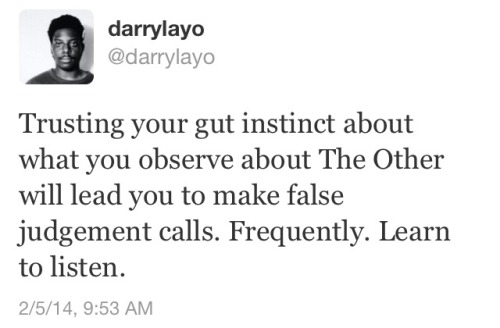
When it comes to treating people well, don't trust your instincts

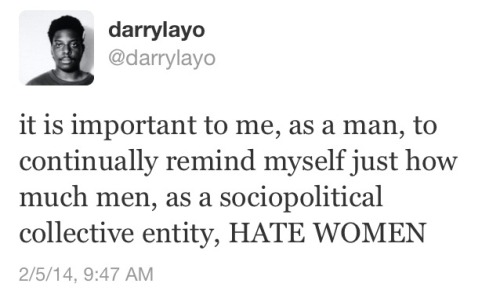
The other day I discovered a particularly brilliant series of tweets.


All of this is brilliant, but the bit about not trusting your instincts really stuck with me. Stereotypes, casual observations of The Other, heirarchies are a poison of the mind that linger like a shadow on the edge of every thought, a darkness just out of view that colors beliefs and perceptions, even when you believe consciously that they’re wrong. 
As the privileged class (men, straight people, white people, etc.), in order to not be awful people, we must wage a constant war of spies and shadows in our own minds, where every thought and feeling, however innocuous, could be an enemy in disguise. We owe it, both to the less privileged around us and to ourselves, to fight this war, to run a background check on every idea and feeling and thought, to treat our own minds as a warzone.
Never assume you’re free of those ideas, because the moment you do, they’ve won.
And listen.

Wednesday, April 30, 2014

King County voters gave a "no" to my employment

Last week, King County voters decided I should lose my job.

Allow me to explain. King County Metro, our local public transit authority, ran into a budget shortfall which it concluded could only be made up by additional revenue or service cuts. Because any and all new taxes here must go to a popular vote thanks to some initiative shenanigans in the late '90s, this required them to put it to a vote: Proposition 1, which would require people to pay an extra $60 for car tabs in order to fund transit and road maintenance.


I work at a local Brooks Brothers store in Auburn, WA. I can't afford a car, so I rely on Route 181 to get to and from work...at least until September, when most of the 181 goes out of service thanks to the rejection of Prop. 1, and I'll no longer be able to keep my job.

But I shouldn't really complain. We live in a democracy, governed by the will of the people, and the people have made clear their belief that jobs should only go to those with vehicles. Or at least, that they're happy to fudge on their reported values if it means a an extra sixty bucks.

Wednesday, April 23, 2014

The Little Girl on the Bus

Just a short thing that happened while taking public transit.

                The little girl with the curly hair looks like a young Jasika Nicole, with a smile just as bright. With her is a woman with hair and features of iron, who stands and sits and never looks up. The girl talks and smiles and smiles and she shows some other girls the dolls she brought with her. “Watch this,” she says, popping a doll’s arm off. The other girls laugh, but then they leave, and she waves them goodbye out the bus’s window.  She presses her face against it, watching every bush and tree and stoplight with equal wonder. I grin and wave and smile with her, and when she drops her warm hat, I point it out.
                The bus stops, and the iron-faced woman stands. She tells the girl with the curly hair it’s their stop, they have to get off. She doesn’t look up. The girl peels her face from the window. She stands, turns to the woman. Doesn’t move. She turns to me, then skips over and wraps her arms around me, tight and unhesitating.
                “Thank you,” says the girl with the curly hair.
                “Yeah, uh. She’s like that sometimes,” the iron-faced woman scowls. She doesn’t look up.
                A moment passes, and I return the hug. “It was good to meet you,” I say.

                “You too,” she says, squeezing a bit tighter before she’s gone.